

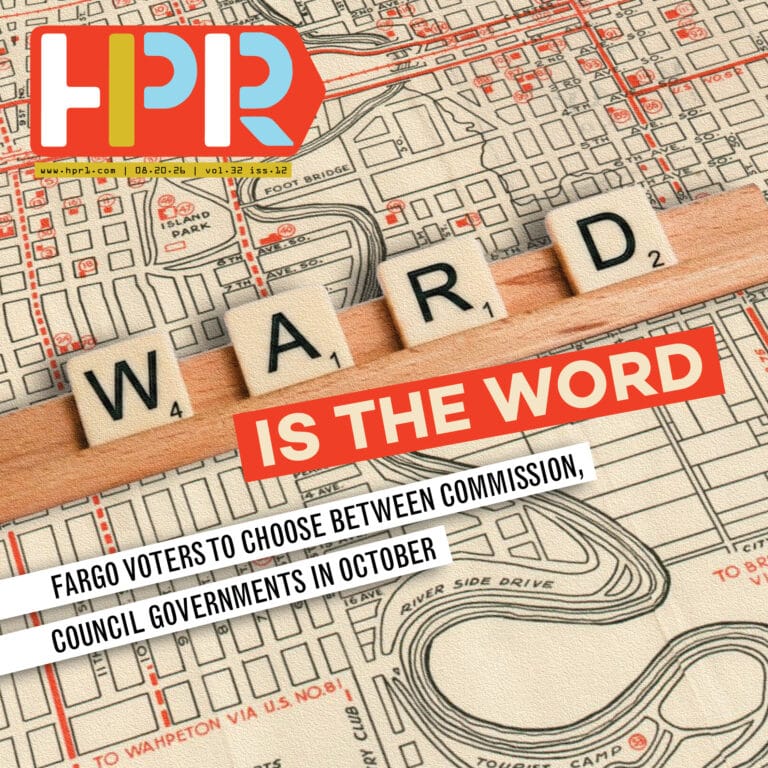
Fargo voters chose to keep the five-member at-large commission form of government instead of switching to a ward-based council on Tuesday, Oct. 6. In complete, but unofficial results, 6,100 (or 56%) rejected the measure, while 4,788 voted “yes.” ”
The difference was most stark at the southside polling place, Atonement Lutheran Church, where 3,086 out of 4,804 (64%) voted against the change. At the Fargodome, the northside polling place, “no” won by 330 out of 2,748 votes cast. And in the downtown polling location, “yes” won by 244 votes out of 1,596. Of the 1,740 people who voted early or by absentee ballot, “yes” earned 142 more votes.
The standalone election with only three polling places had a high turnout —10,888 people cast ballots, about 3,000 more than voted in the previous citywide special election on a Fargodome tax in 2023. Results in the election, which was administered by the city instead of the county, were slow to come in due to the ballots being hand counted at each polling place. The Special Election Canvassing Board will meet in the city hall’s Red River Room at 11 a.m. on Monday, Oct. 19, to certify the results.
Although he was a proponent of change, recently elected Mayor Josh Boschee readily accepted the results when reached by phone Wednesday morning.
“Clearly, our voters have spoken, and so we’ll continue moving forward as is,” he said, emphasizing his satisfaction at high voter turnout. “With a special election, you never really know how many people are going to show up.”
Boschee added that it’s important that citizens stay engaged. He advised residents “to come to city commission meetings to share their thoughts on things or reach out to commissioners…we want to make sure we’re continuing the conversation, regardless of the form of government.”
Boschee’s immediate predecessor, Dr. Tim Mahoney, was an advocate for the “no” campaign. He said high voter turnout boded well for his side.
“I thought if people would get out and vote, it would defeat the measure, which is exactly what happened,” he said, arguing that the more voters learned about the potential change, the less likely they were to support it. “I’m glad people showed up and voted. That’s what I was concerned about and I was very pleased.”
While noting that high voter engagement was a good thing, Arlette Preston, a long-time local public figure and leader of the pro-measure group Fargo Wards for Equal Representation, called the result “disappointing.”
Fewer people voted for the measure than the number of signatures submitted to put it on the ballot. Petitioners handed in 4,947 signatures in early June. After the city verified enough of them the following month, city commissioners scheduled the special election at their Aug. 3 meeting.
If the measure had been approved, an independent city committee would have drawn six wards of equal population. Voters would have selected one council member from each ward in the June 2028 election. Half the council would be up for a vote in each election.
The position of mayor, which wouldn’t have been up for a vote until the regularly scheduled 2030 election, would have continued to be elected at-large. In the current system, the mayor votes in all cases. Under a ward system, the mayor would only have voted in case of a tie — and would have possessed veto authority that two thirds of the council could override.
Support for and opposition to the measure crossed party lines, with fiscal hawk Tony Gehrig and the more progressive Preston — both former Fargo City Commissioners — teaming up to push a “yes” vote. Meanwhile, Mahoney — considered more left-leaning — and ardent conservative commissioner Michelle Turnberg joined forces to oppose the ward switch.
Supporters argued that Fargo would run better with council members who represented specific sections of the city who would be more attuned to citizens’ needs. Opponents said that change was unnecessary and would create parochialism on the council, rather than a commission looking out for the best interests of the entire city.
Preston said she likely won’t lead another effort to switch city governance. But she told the High Plains Reader that change of some sort is still a possibility at some point.
“I do think that (the vote) has stimulated a discussion in the community, which I don’t think will go away,” she said. “I truly believe there’s interest in making some changes, but not this particular one at this particular time. (The election) hopefully moved this whole discussion forward.”
 Minnesota Voter Guide: Clay County Board editionSep 24, 2026
 Moorhead Voter Guide: City Council EditionSep 23, 2026
 Voter Guide: Moorhead Mayor EditionSep 20, 2026
 Farmers in crisis: mental health matters on the prairieSep 16, 2026
 Farmers in crisis: recalculation in farm countrySep 4, 2026
 Fargo voters to choose between commission, council governments in OctoberAug 20, 2026