
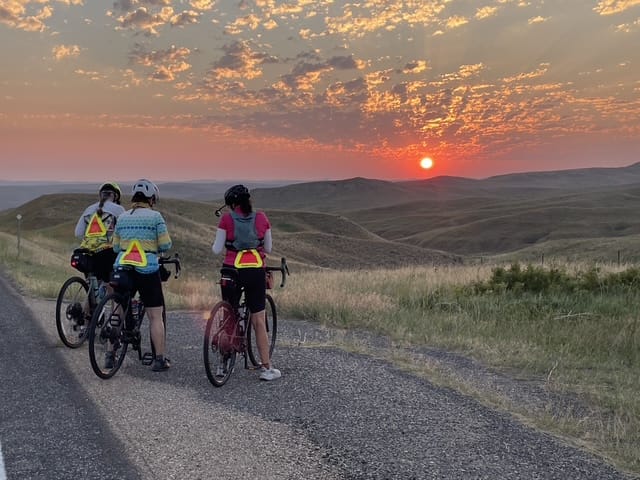
Most days there isn’t too much traffic on Highway 46 in Lamoure County. The towns that still line this road in southern North Dakota are few and far between. On August first, 24 cyclists made their way down this rural ribbon of highway as they biked down the homestretch of their nearly 2,000 mile journey. The venture was coordinated through WomanTours, a bicycle touring company for women, owned by women.
The route started in Anacortes, Washington and wound through forests, mountains and prairie. The final destination for some was Fargo. Others bike onward to Bar Harbor in Maine.
WomanTours was started in the mid-90s by Gloria Smith. It began when Smith wanted to do a cross country bike ride — but without men.
So she put an ad in the paper and got an overwhelmingly positive response. She rounded up a group of women, had friends cook along the way and the riders made their way across the southern part of the U.S. From there, she established a northern route, two coastal routes and a middle route — and the company blossomed.
She sold the company to its current owner in the early 2000s. And from there, WomanTours has gone international, doing bike tours all over the world.
Connecting a community of female riders
“We are seeing women in the second half of their life; you know, kind of in the 50 to 80 range,” said WomanTours tour specialist Abby Noon. “We’ve got some younger girls and we even have some older. I think I saw on one of our rosters that we had an 86-year-old coming on one of our trips. It’s mostly retired women, or women who are close to retirement age.”
Many hear about the tours via word of mouth. Others may have participated in a previous tour, but this time they’re bringing a friend, aunt, sister or daughter (as long as she’s 14 or older). Some come as a group, while others come solo and make friends along the way. Some even come back the next year for another tour route.
Some women are experienced cyclists, others are just getting started on their cycling journey, while others might just like the idea of an active vacation. Each tour is rated as leisurely, moderate or advanced. And each tour is truly a once in a lifetime experience.
The tours last for 50 days. The cyclists average 50 miles per day, with a break every five days, staying at hotels along the way. The cyclists are followed by a van and trailer.
“We have a trailer that’s outfitted with a little two burner stove and a couple big coolers. We have a chef that cooks a home cooked meal for them every night in the hotel parking lot, and we all make a little circle with camp chairs,” Noon continued. “The guides debrief on the day. It’s a really nice way for the group to reconnect every evening because they bike at their own pace.”
The meal isn’t just about food. It’s about connection.
“Dinner time is kind of our time to be social,” Noon said. “Everyone can ride the same route on the day and all experience something totally different.”
How does one train for a 2,000 mile bike ride?
“You can’t think of it as 2,000 miles because that’s overwhelming,” said Noon. “f you are someone that rides a bike casually and you’re like, ‘I’m gonna go ride 2000 miles,’ that’s too much. You just think about it like, can I ride my bike for three or four hours at a time at any pace? And then you just kind of build it up with longer rides and get your body used to being on the bike for part of the day.”
“A lot of fitness does come from just starting the trip,” she continued. “And the first few days are really hard, and then your body kind of just gets used to it. On our tours, we have support stops every 20-ish miles, which is roughly every few hours, so you get a refill of snacks, you get a refill of water, you get a refill of encouragement. There’s also a van that can pick you up if you can’t make it the whole day. So there’s kind of this built-in safety net that I feel like often helps people go farther than they might otherwise.”
That almost feels like a lesson in itself.
“It totally becomes this metaphor for life,” Noon said. “And ultimately, at the end of the day, these detours are often more mental than they are physical. Once your body is used to it, it’s just being able to convince yourself that you can keep going,”
Inspiring sights and rural life
Noon also mentioned that biking through the national parks was a big draw for cyclists. But there was something about North Dakota that really struck a chord. Noon said the cyclists enjoyed the rolling fields, the birds and the number of large sculptures in the state, including the big buffalo in Jamestown and the world’s largest Sandhill crane in Steele.
“You have just kind of these big ticket, flashy locations that everyone knows about, but it’s really these small, sweet, hidden gems along the way that became what stood out for them,” Noon said.
In addition to our landmarks and landscapes, cyclists also had the opportunity to take in a slice of rural life along the way.
“They really got to know the small towns and people in small towns,” Noon said. “I feel like in North Dakota and in Montana, people are curious. People are curious about why someone would be on a bicycle in these small towns and they strike up conversations. We always encourage everyone, when you get to your hotel go into town, go walk around before check-in. This group of women in particular really took us up on that. They were going to all the lemonade stands that they could find, and the libraries and the pools, and they had all these conversations with locals. Most of our women are from cities, more urban areas, more suburban areas, and they have not spent time in rural America. And they were just like, ‘This is so cool to get this glimpse, and everyone here is so friendly. It was not what I expected — in like, the best way possible.’”
 Bucket list travel: ‘100 Things To Do in North Dakota Before You Die’Sep 21, 2026
 A tale of two cities: food and art in Columbus and Dublin, OhioAug 13, 2024
 A Fox Cities ChristmasNov 22, 2023
 Small Town Spotlight: Why Not Minot?Sep 27, 2023
 What’s new in MedoraAug 17, 2023
 The Kulm bank caper: a 97-Year-Old cold case on the prairieJan 7, 2023