
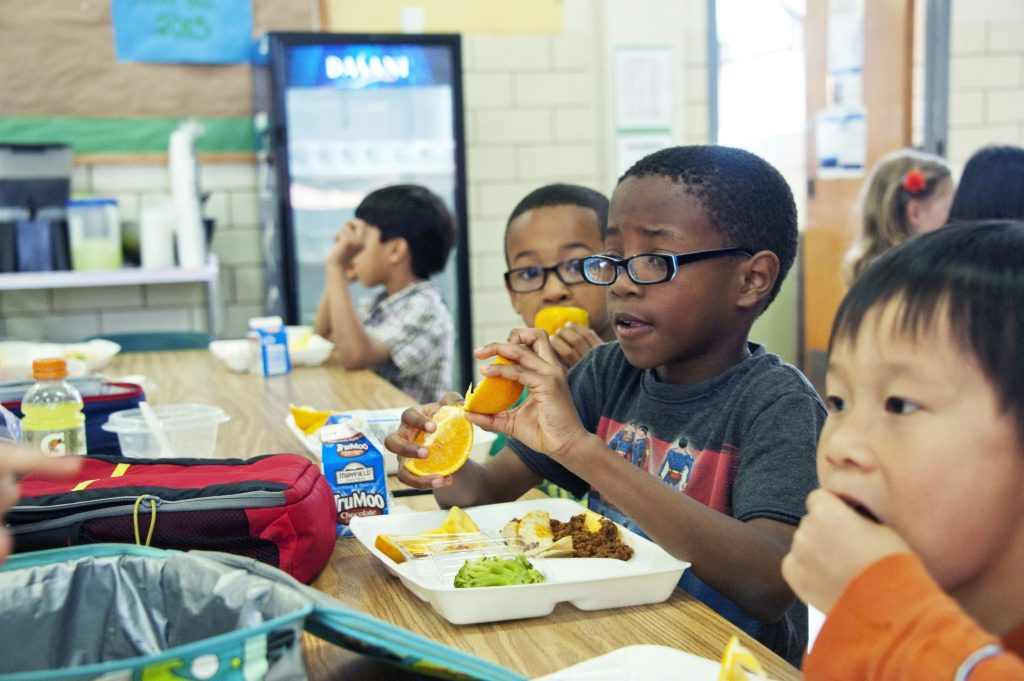
As a public school teacher and education professor for 41 years (and a public school student and parent of two public school students) I realized how little I knew about school meals — free, reduced and paid — and the powerful and important role these meals play in students’ lives. I suspect many readers might not know much about these critical practices and policies and the importance they play in students’ lives either. So, here goes.!
Public school students typically receive what they need in school, like books, desks, computers and transportation. Yet we don’t ask families to pay extra for any of this — all students get them as a normal part of school attendance. I wonder why school meals aren’t thought of in the same way, even though they are foundational to student academic achievement, and social-emotional well-being.
Locally, this discussion is important. Minnesota has already legislated a universal meal program that offers free meals, while North Dakota will vote November 3 on Measure 2 that would fund, “one breakfast and one lunch each school day to enrolled students at no cost to the student, parent, or guardians” beginning in the 2027 school year. I am glad I live in a state that has already made this commitment to all students.
Where it all began
The earliest precursor to school meal programs was an anti-poverty program in Germany in 1790. Poor students attended school half days and worked half days in return for hot meals. This experiment gave way to large scale meal programs across Europe and later England. In the United States, one of the first school-based meal programs was in Boston in 1908. The penny lunch program was an early 20th century plan to provide reduced priced meals to poor children attending urban schools.
The Depression resulted in widespread poverty, with millions of school age students facing hunger daily. To help, the federal government legislated lunch programs across the country. This is how it worked; during this time, diminished purchasing power reduced demand for farm products, leaving farmers with financial troubles. In response, the federal government’s Works Progress Administration (WPA) purchased surplus commodities through the New Deal and distributed them to schools at no cost. These programs, across 39 states, served 500,000 meals at 10,000 schools daily by 1937.
Initially the audience was only poor children. But it was soon realized that all students would benefit both academically and socially-emotionally from nutritious lunches. In Minnesota, teachers and officials found that WPA-fed children attended school more regularly and concentrated on their studies more.
In 1946, President Truman put the permanent federal government stamp on school lunch programs by signing the National School Lunch Act (NALSA). Because many men were declared unfit for WWII military service due to physical deficits, this act was considered a National Security measure to improve the health and well being of the nation.
Lunch meals under this act were required to meet nutritional standards, use local commodities, operate on a non-profit basis, discourage discrimination and segregation and maintain appropriate documentation. Family income limits for free and reduced price meals and matching federal government meal reimbursements have served as the foundation for these programs.
These limits have changed over time. Since 1981, the free breakfast and lunch family income limit is 130% of the federal poverty level (FPL). Under this system, a family of three’s annual income cannot exceed $35,516 to qualify for free breakfasts and lunch.
The reduced price breakfast and lunch family income limit is 185% of the federal poverty level. For example, to qualify for reduced price meals, a family of three’s income cannot exceed $50,542.
During the 2025-2026 school year, 73% of the nation’s public school students qualified for free or reduced cost meals. Federal meal reimbursement dollars have always fallen short of offsetting meal costs, so states, districts and families have to make up the difference.
Providing nutritious meals for more students has long been at the forefront of federal legislation. Monies for school breakfast, milk, food service equipment and preschool food programs were added by President Johnson through the 1966 Child Nutrition Act. Congress authorized breakfast as part of this newly mandated federal government responsibility.
The 2010 Community Eligibility Provision (CEP) is an effective example of federal action allowing more students to receive free meals. A high poverty school means 75% or more of the student body is eligible to receive free or reduced price breakfast and lunch. Several presidents, including Lyndon Johnson, Richard Nixon, Barack Obama and Joseph Biden followed Harry Truman’s 1946-lead and advocated for legislation to increase the federal government’s responsibility in providing more nutritious meals for students. There are two presidents who are the exceptions to this rule.
In 1980, Ronald Reagan cut $3 billion from child nutrition programs, lowered family income limits and reduced the federal government’s reimbursements for meals. These changes reduced the number of students eligible for free and reduced-price meals and put more financial pressure on states, districts and families.
Trump made serious cuts and restrictions to safety net programs like Supplemental Nutrition Assistance Program (SNAP) and Medicaid. He also cut food allocations, which made problems worse for families trying to overcome food insecurity, according to the Center for American Progress.
Food insecurity is officially defined by the U.S. Department of Agriculture (USDA). It means not having enough nutritious food to eat and not knowing where the next meal comes from. Nationwide, nearly 20% of students meet the definition of being food insecure, with about 33% of this group being labeled ineligible for subsidized meals due to just missing rigid family income limits. These numbers are higher for students of color.
Trump’s actions makes states, districts and families (instead of the federal government) more responsible for school meal costs. Here are three examples. The $1 billion in USDA cuts for food purchasing will be hard to replace. Trump’s One Big Beautiful Bill results in millions of families losing $186 billion over 10 years in SNAP benefits. This includes 1.5 million children who face losing their school meal eligibility, as SNAP is an important key to eligibility. These families will face an extra food cost of two thousand dollars per child annually if required to pay full price for school meals. The Trump administration is also trying to increase family income limits, thereby reducing program eligibility. What would Presidents Truman and Johnson say about these anti-family policies?
North Dakota’s Together for School Meals is a grassroots non-profit organization campaigning for Measure 2 on the November 3 ballot. This citizen-initiated measure, signed by over 50,000 citizens, is widely supported by 81% of North Dakotans and 80 organizations. This organization believes universal meals are a lifeline for food insecure students and a winning way to help all students achieve academically and thrive socially and emotionally. They also believe that the $134 million dollar two-year cost (out of a $20 billion two-year budget) to provide breakfast and lunch for the state’s 120,000 K-12 students is well worth it.
I could not agree more. Funding would come from normal legislative processes and, if necessary, Legacy Fund earnings. Families would actually save about a thousand dollars per student, per year.
Opponents see high risk, little reward, with a slippery slope that could lead to similar measures, like universal childcare. I see universal meals and childcare as just the opposite —low risk, highest reward. If Measure 2 is defeated, about 12,500 North Dakota food insecure students who live in households with incomes just above the limits for subsidized meals will continue to be ineligible for them — which would be a sad day.
England’s Education (Provision of Meals) Act 1906 tells the age old truth about the importance of meals for all. These century-old writings illustrate the building blocks used by nine U.S. states, including Minnesota in 2023, to create universal breakfast, lunch, and snack programs for all students.
“…such food as the local education authority may consider requisite to enable the said children to take full advantage of the education provided for them,” the act reads. “Suitable meals shall be available just as much for those whose parents are in a position to pay, as for those to whom food must be given free of cost.”
Universal meals for all
Too many American school age students are hungry, with 30 million relying each day on subsidized lunch and 16 million relying on daily subsidized breakfast, according to the USDA. In order for public school districts to conduct a free or reduced meal program, kitchen staff must organize and manage the federal government’s free and reduced price meal plan. This plan requires wide ranging, extensive and ongoing reporting to validate meal reimbursement, debt recovery and program compliance, consuming hundreds of staff hours. These costs would be eliminated under a universal meals program.
We know for a fact that when students come to school hungry, the likelihood they will experience academic, behavioral and social-emotional problems increases. Not having regular and nutritious meals and not knowing where the next meal comes from (food insecurity) results in students struggling with concentration, memory and engagement. They may have poor academic performance, low attendance and behavioral problems leading to suspension. Food insecurity also impacts students’ mental well being, increasing rates of anxiety and depression. Often, students receiving free or reduced-priced meals are “meal shamed” and stigmatized by peers as “poor kids.”
In total, these struggles make learning to read and do math more difficult and can result in higher numbers of special education referrals, repeating a grade and dropping out of school. And states and districts struggle financially because the federal reimbursement meal plan leaves unpaid bills.
Nine states have legislated universal breakfast and lunch meals for all students, regardless of their household income, including Minnesota. Minnesota’s three-year program served over 450 million meals and saved its families $270 million dollars during this time as well. The number of students eating school meals has significantly increased during this time. Reducing the strain on family budgets is a win-win for American families, particularly with food prices so high.
Now households with incomes just over the 185% federal poverty level are handcuffed by meal costs. For example, a single parent with two students making $50,500 would not qualify for free or reduced meals. Imagine the hardships that universal meals would eliminate. North Dakota, since 2025, has raised this level to 225% FPL. This legislation is certainly a step in the right direction.
So, why is it so important for all states, including North Dakota, to legislate universal meal programs? The Food Research and Action Center reminds that all students benefit
Universal school meals reduce childhood hunger, increase food security and produce higher rates of attendance.The program enhances learning and academic achievement, particularly in math and reading and lessens classroom disruptions and school suspensions. It ends meal shaming and removes the burden of district administrative oversight and saves significant dollars. It promotes health outcomes, puts an end to meal debt, ad puts more money back into families’ pockets.
Nine out of 10 Americans believe that hunger limits students’ learning and interferes with their well being. They don’t buy the opposing arguments that this program costs too much money, takes away parental responsibility and the right of personal decision making, leading to massive fraud and too much big government. They are right.
The big picture
Because school is compulsory, shouldn’t school meals be too? Universal meals are the most efficient and equitable solution to food insecurity and promotion of overall student well being. Students receive nutritious meals and know they will have access to them. Isn’t this something we want for all students?
The federal government should eliminate the current free and reduced pay eligibility system and reimburse all schools for total meal costs. The federal government spends about $24 billion per year for the existing school meal program. Changing this program to a universal one would raise costs about $10 billion per year. Providing this essential ingredient that contributes to the success of all students would cost a fraction of the federal budget.
Let’s hope North Dakotans vote yes on Measure 2 on November 3 and put students first.