
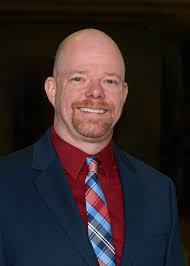
Chad Peterson, a lifelong Fargo resident, won his race for the Fargo City Commission in the June 9 election, the top vote-getter in an eight-way race. A northsider, Peterson was a Longfellow Lion, Ben Franklin Wildcat, Fargo North Spartan and North Dakota State University Bison. He’s run several small businesses over the past three decades and has held ownership stakes in commercial and multi-family properties. He frames his private-sector record — balancing budgets, meeting payroll, navigating regulations and creating jobs — as the foundation of his conservative, low-tax and low-regulation approach to governing.
Peterson previously served three terms on the Cass County Commission from 2012-2024, representing north Fargo and completing several stints as commission chairman. His work at the county level brought statewide and national attention, including his earning of the Commissioner of the Year Award from the North Dakota Association of Counties. Before his election, Peterson had served on numerous local boards including the Cass County Planning Commission and the Fargo Board of Adjustment.
Peterson announced his campaign for Fargo City Commission in mid-March, vying for one of two seats vacated by commissioners Denise Kolpack and Dave Piepkorn, who were both candidates for the open mayor position. He earned 18 percent of the vote in a competitive eight-way race to claim one of the two open seats.
On July 6, he was sworn into office by Cass County Judge Stephen Dawson, alongside fellow new commissioner, Fargo School Board member Nikkie Gullickson and Mayor Josh Boschee. The packed commission chambers gave the newly elected commissioners and mayor a standing ovation.
Peterson told the Forum of Fargo-Moorhead that his goal is to “make City Hall boring again.” As a part-time commissioner, he will make nearly $31,000 a year. Peterson joins the commission during a potential transition to a six-ward system. If the petition is validated and approved by voters, it would trigger a special election that would change the way commissioners, who are currently elected at-large, would attain office.
High Plains Reader caught up with Peterson in between his victory and his swearing in. He talked about how he views his role as commissioner, what his priorities will be and the premium he places on being available to the general public.
High Plains Reader: What do you view as the role of a city commissioner?
Chad Peterson: It’s a broad view, rather than a specific view. I see a commissioner’s role as not necessarily advocating for different departments. Rather, they take the broad view of advocating for the entirety of city needs.
We had a great board at Cass (County), but I’ve seen a lot of boards where you have — and not just boards, but elected leaders — where you have very specific interests. And really, they start digging into one specific topic and that’s all they invest themselves in. And things that they find less interest in, they don’t necessarily spend the time — or they look at their peers for basic recommendations and that’s how they achieve consensus on things. And that’s okay sometimes, but a commissioner should have a broad understanding of what we do as a whole, rather than taking a target on one place or one specific department and saying, “This is my focus, this is my interest and everything else is sort of boring to me” So (the role of a commissioner) is guiding the city forward, as a whole, into its future.
HPR: How did 12 years on the county commission, including some stints as chairman, prepare you for this new role?
CP: I think it gave me a good understanding of what local government is supposed to accomplish. And that was sort of the tailoring of my campaign, too. It’s staying within the guardrails of what the city government should do, as I did previously with the county government.
We’ve sort of started migrating into different things. And you can agree or disagree with what they’ve done and the methodology and the means behind that. But the rationale is, if the city can stick to what it does (or what it’s supposed to do) and does it very well, I think we’ll all be better off.
More importantly, the resources allocated towards those things we’re supposed to be doing, will be more. So we’ll be able to do policing better. We’ll be able to do fire protection better. We’ll be able to do infrastructure better, sanitary sewer and all the things that play down the line from sort of those big market things that everyone understands that cities do. And I think that, to me, is the net end result. It’s understanding what local government is supposed to do, staying within the guardrails, so we can accomplish our mission at a premium.
HPR: What about your private sector experience? How did that prepare you for this role?
That’s an interesting question. So my background is architecture; my background is construction. I owned a large architecture engineering company for 15 or so years, plus or minus. I’m on my own now, but — long story short — as I’ve owned multifamily and commercial properties most of my life, worked for architects, worked for engineers, worked for developers in the past, that has really taught me within this one realm of what the cost of permitting can be.
When we talk about affordable housing, everyone thinks of subsidized housing. Well, that’s just not true. Affordable housing should be affordable for all of us. What can I do to decrease the cost of construction so the average homeowner can afford to purchase their home? Affordable housing should be, simply, how can I allow builders and developers to build homes people actually want to buy at a price they can afford? That’s affordable housing too. So to bring my breadth of knowledge in construction will be a great benefit to the city.
We used to be able to pull a permit in the city of Fargo in 15 minutes. You used to be able to walk in with a sketch on a napkin and have a building permit handed to you. Now, is that too simplistic? Maybe. But not always.
You don’t need to have massive government oversight. We’ve got building codes. People can’t just build what they want; those codes exist. And simply having the city follow the building codes —and if you’re willing to do that as a developer and as a builder — go do that.
But having the city impede those things with time delays and plan reviews that take way too long, that affects how much you’re paying for rent, so that if you’re an apartment renter, all those costs go into your rent. So if it takes me two more months to build because the city can’t get me a building permit fast enough, that increases what you’re going to pay for rent.
If you’re a homeowner and it takes six months to get your plan through a review, that’s going to impact the price of your home. It’s hard for a lot of people to understand this, but that’s what this is — the carrying costs always pass on to the consumer, whether you’re buying a house or buying an ice cream cone from the ice cream store that took six months too long to get a permit for. So if the city can streamline, like it used to, that’s going to save us all a ton of money, with costs being so exorbitant.
When I was young, a million bucks was a ton of money. A million bucks isn’t anything right now. We have multiple homes worth more than a million dollars and thirty years ago I couldn’t even process that kind of house in Fargo. Anyway, my breadth of knowledge in (the construction sector) is going to be helpful.
HPR: How should the city adjust its budgeting process? Specifically, can you talk about the zero-based budgeting model that you propose?
CP: Yeah, in fact, we’re already doing that. I had a meeting with Mayor-elect Boschee. We were at City Hall yesterday getting a briefing from Mayor Tim Mahoney and some of the department heads. The process I’m wanting to do has already started. They listened to what we talked about during our forums and some of them specifically brought up some of the things I commented on. And we had eight good candidates running for city commission. You had five good candidates running for mayor. So they listened to all of us, but it was fun to hear them say, we listened to some of you speaking and we took that to heart.
What we’re hopefully going to do is slowly migrate ourselves into the way the county does budgeting. Zero-based budgeting is just that. You take your baseline expenses — those fixed costs — and you build that as your base.
And you go up from there with staffing and other things you’re going to have to spend money on no matter what. You’re not going to fire anybody — or rarely will anybody get fired. So you have that as your second baseline.
And from that point on, then you grow. That’s inclusive of new full-time employees, FTEs (full-time equivalent), that’s inclusive of cost of living adjustments (COLA) and step increases.
What typically happens in a lot of city governments — and I’m not just picking on the city of Fargo — very few, if anyone, does their budgets like Cass County. It’s not just local governments here in Cass and in Clay, it’s everywhere. What they do is: We spent a hundred million dollars last year, let’s just spend five percent more, so we’re spending $105 million.
That’s not the way budgets should be done. We don’t do that as homeowners. We don’t do that as business owners. It’s very easy to do that because local government is quite complex (state government is also quite complex) so if you don’t necessarily know what you’re looking at and you don’t have the time or the desire to dig into the weeds like I do. I love this stuff. Most people find it a bit monotonous and boring. I love it.
I think we’ve got one good mayor. We’ve got four good commissioners coming into City Hall. It seems like everyone’s going to want to engage. And the budgetary process to replicate what we’ve done at Cass has already started. It’s going to take time, because it’s a big step. It’s a heavy lift for our team. Plus, the way we do elections puts the stress and strain on three of us.
Luckily, I have local government experience. And again, Mayor-elect Boschee is going to be great, too. He’s got state government experience. And commissioner-elect Gullickson is also great. She’s got local government elected experience. So luckily, you have three people with some experience in budgeting.
HPR: How do you plan to address special assessments?
CP: With special assessments, in my three, four months of talking to folks specifically about this item, there’s a good number of people who firmly believe that when special assessments go away, their sewer, their water, all of those expenses go away. We’ll have free sewer, free roads, free water — all those things that go along with that. And that’s not the case. And this was not just an off conversation with one or two people. There’s a good number of people who thought “No special assessments, no bills.” And that is not the case.
The reality of it is, it’s far different from that. So to quantify these things, look to a new development. In a new development, you simply attach that bill to the lot.
The trouble comes when you have an existing home that’s been here 30, 40, 50 years when you need new sewer, new water, new storm sewer, curb — whatever it is. When you come back and assess that toward the property, does that homeowner understand you’ve got to figure out how to pay for that now? It’s not just free. Someone has to pay for the thing that’s improving your house. Too many people out there believe it just doesn’t cost us anything anymore — I get free roads, free sewer, free water. No. There’s a bill there. Someone has to find dollars for that.
This is done all over the country. Special assessments are not unique to our area. I want people to understand the whole picture. It doesn’t simply come from the Fargo money tree. We can’t just wave a wand. There are downstream impacts that the people I’ve talked to don’t understand.
I think what we need to do is have an open forum and make it so easy that everybody understands. This is way more complex than saying this should simply go away. I think dialogue is the most important part. Whatever happens, happens.
Fargo voters are incredibly intelligent. They just want to know what’s going on. They want someone to explain to them — “Here’s what we’re doing. Here’s why we’re doing this. And here are the ramifications of what we’re doing.” Our voters are great. They always have been.
HPR: So you consider yourself a conservative, correct? And do you think it’s important for commissioners to stay above the partisan fray?
CP: Oh yeah I’m conservative. I’ve hid that from no one. I’ve been a conservative my whole life. But to your second point, politics doesn’t engage in local government. When you flush the toilet, no one cares if the pipes are Republican or Democrat. They just want the things to go away to a treatment system where things are taken care of. And that’s what makes local government so strong. The things that divide us politically, we don’t do those things.
We don’t legislate on the local level, we simply administrate. We leave the legislation to the people who legislate. That’s the Bismarck folks. That’s our friends in D.C. and everywhere in between. We don’t do that. And that’s one of the reasons I really like local government because you take the politics — the areas of division — and you leave them to the people who have interest in them. It’s very different from local government. Yes, I’m conservative, but I don’t know why that matters at the local level.
HPR: If you could pick two things that you could accomplish during your term, what would they be?
CP: The main things are budget transparency and making sure our public safety is well funded and well managed. And public safety includes everything from our dispatch centers to our firefighters and police.
HPR: What should the city do about the unhoused population and what other public safety measures would you like to see?
CP: Long story short, it’s not just the homeless population, it’s our friends who are mentally ill and chemically dependent; it’s all of those folks. And what I’ve been saying is the city of Fargo is paying for the regional healthcare for all of the people who are having some struggles. The city of Fargo will never have enough people, the city of Fargo will never have enough money. Fargo’s not an expert in these areas.
So what should happen is, the state needs to come in and help us. We must be partners. The county must be a partner. But the city of Fargo taking it upon themselves as we have to fund these things independently, the math doesn’t work. We’re not experts in these areas. Experts need to be allowed to be experts and we’ll never have enough revenue to deal with these folks in a positive way.
HPR: Finally, you ran on transparent, collaborative government. What does that look like in action?
CP: Step number one is the budget. I think I’ve talked enough about budget transparency. But one thing I haven’t talked to is the availability of the commissioners. The commissioners and our mayor need to be available to the public.
I prided myself in that, when I was on the county commission for 12 years, I was the main person on TV. I was the main person on the radio. I was the main person in the paper, because I felt it was my job to be available to the public at large. So if some of these panels and committees disappear, it’s not because the need or the concerns disappear. It’s just that we’re refocusing.
The way I treat this is, if the city commission gets rid of some of these things (Human Rights Commission, etc.), it’s incumbent upon me to be more available. It’s not that whatever problem there was just went away, it’s just I’m taking out the middle man sort of group.
If you have a problem with x, y and z, I’ve never been hard to get a hold of. I’ve got 12 years of history of that. And I’ve never been afraid to talk to anyone. Whether we agree or disagree in the end, that’s okay. We need to have that dialogue. Availability is paramount. Because if our citizens feel the government’s not listening to them or not available to them, that’s a big problem.
 A chat with AAA about high diesel pricesOct 14, 2026
 Fargo voters reject switch to ward-based council governanceOct 7, 2026
 Minnesota Voter Guide: Clay County Board editionSep 24, 2026
 Moorhead Voter Guide: City Council EditionSep 23, 2026
 Voter Guide: Moorhead Mayor EditionSep 20, 2026
 Farmers in crisis: mental health matters on the prairieSep 16, 2026