
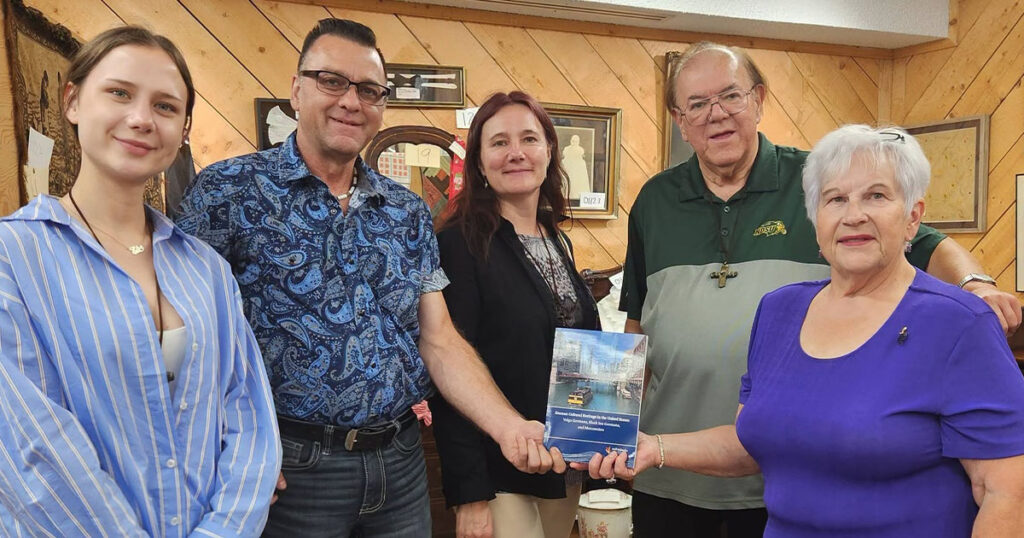
On August 27 and 28, 2026, Dr. Olga Litzenberger, and her daughter, Lisa, traveled with me to visit the Germans from Russia Heritage Society (GRHS), the North Dakota Heritage Center and State Museum in Bismarck, the Welk Homestead State Historic Site and Sts. Peter and Paul Catholic Church in Strasburg, the old St. Mary’s Cemetery and St. Mary’s Catholic Church in Hague, the McIntosh County Heritage Center in Ashley, and the Jewish Homesteader’s Cemetery northwest of Ashley. Dr. Litzenberger is a historian for the Bavarian Cultural Center of Germans from Russia in Nuremberg, Germany. Lisa, who speaks fluent German, Russian and English, served as translator. Olga and Lisa, both of Volga German heritage, were born in Saratov, Russia, and immigrated to Germany.
They began their visit to North Dakota by touring the Germans from Russia Heritage Collection (GRHC), NDSU Libraries, in Fargo. They were impressed with the new permanent exhibit, “In Search of a Homeland: Journey to the Germans from Russia.”
“For me, as a historian, it was particularly interesting to see how scholarly knowledge had been transformed into a compelling museum narrative, for my daughter, how this history can speak to a younger generation.” Dr. Litzenberger shared. “The exhibition conveys a sense of thoughtful, sustained work grounded not only in professionalism, but also a deep respect for the people whose lives and experiences it represents.”
The German guests were interested in homesteading, farming and the landscape of the Black Sea Germans who emigrated from the Kutschurgan villages today near Odesa, Ukraine to settle in south central North Dakota. They shared how similar the prairie or steppe landscape is to Ukraine, the Volga region of Russia and Kazakhstan of the former Soviet Union.
At the GRHS in Bismarck, flowers were presented in memory of the Day of Remembrance of the 85th Anniversary (1941-2026) of the deportation of thousands of Germans in the former Soviet Union to slave labor camps in Siberia, Russia, and Kazakhstan during World War II.
“Our visit to the Welk Homestead was one of the warmest and most memorable moments of this trip,” they wrote. “We were especially touched when a tour was conducted for us in German by Robert Hanna of the SHSND. This immediately created a different atmosphere and unexpectedly strengthened the sense of connection between past and present. Moving through the sod house and farm buildings of the Welk family, one becomes aware not only of individual historical facts, but also of the lived experience of the settlers themselves: their everyday routines, labor, adaptation to new surroundings, and efforts to preserve familiar ways of life. For us, this was more than a visit to a historic site; it was a very personal encounter with the world of people whose history is closely connected with the broader story of the Germans from Russia.”
Marvel (Dalke) Haas Gross, president, and Randy Woehl, vice president of the McIntosh County Historical Society, provided an informative tour. The guests from Germany were presented a handmade iron cross necklace souvenir made by Marvel’s son, blacksmith Bradley Haas.
“We were especially moved by the warm and personal welcome from descendants of Black Sea Germans, Marvel Gross and Randy Woehl,” Dr. Litzenberger commented. “For me as a historian, it was particularly meaningful to hear what this heritage continues to mean to the descendants of the settlers themselves. It is precisely through people like these that small regional museums acquire special significance. They preserve not only objects and documents, but also a personal relationship to the past.”
“When the ancestors of many North Dakota families came here from the Black Sea German colonies, the journey took weeks,” Dr. Litzenberger continued. “Today, the same distance can be covered in hours. For me as a professor, it was especially interesting to see what has survived for more than a hundred years.”
“Both of my dissertations focused on religious life, especially the history of Lutheran and Catholic communities in the Russian Empire and the Soviet Union,” she added. “Because of this, I naturally look at places like these through the lens of my professional experience and compare different historical models. In North Dakota, I saw a very different path of development: many religious and cultural traditions here were able to survive and be passed down from one generation to the next. For me, this comparison was one of the most interesting parts of the trip.
“But the strongest impression was made by the people … and we are leaving with many new friends. We were welcomed with great warmth, and I was especially impressed by how well people know the history of their families and communities. I am very grateful to everyone who shared their stores, traditions, and time with us.”
“Since I was little, I have traveled with my mother on historical and ethnographic research trips,” Lisa added. “I grew up visiting old German churches, cemeteries, and former German settlements in Ukraine, Russia, and other countries. I often heard stories about the people who once left these places. Before this trip, however, the North American chapter of this history was something I knew mainly from stories.”
“In central North Dakota, I had the opportunity to see how this history continued on the other side of the ocean,” she continued. “It was especially interesting to discover familiar details in the churches, old crosses, family traditions, and even the food, while at the same time seeing how, over several generations, these traditions became part of a completely different country and way of life.” (During their visit, they ate chokecherry kuchen, pickled watermelon, canned sweet sauerkraut, kase knoephla and knoephla soup at the Hague Café.)
“What impressed me most was that history here is not something found only in museums,” Lisa wrote. “It is told by people and preserved in families, homes, cemeteries, recipes, and family photographs. For me, this journey is a continuation of all the trips my mother has taken me on since childhood, but at the same time it opened up an entirely new world.”
For more information about donating family histories and photographs, or how to financially support the GRHC, contact Jeremy Kopp at [email protected] or 701-231-6596; mail to: NDSU Libraries, Dept. 2080, PO Box 6050, Fargo, N.D. 58108-6050; or go to .ndsu.edu/grhc. You may contact me at [email protected] or 701-231-8416.
 Bucket list travel: ‘100 Things To Do in North Dakota Before You Die’Sep 21, 2026
 Solving the hormonal keysAug 30, 2026
 Homesteading insights from the roadAug 30, 2026
 Girl power on the roads less travelled Aug 7, 2026
 Fargo-Moorhead Pride celebrates 25 yearsJul 26, 2026
 Still life yoga with Casey WollschlaegerJul 9, 2026