
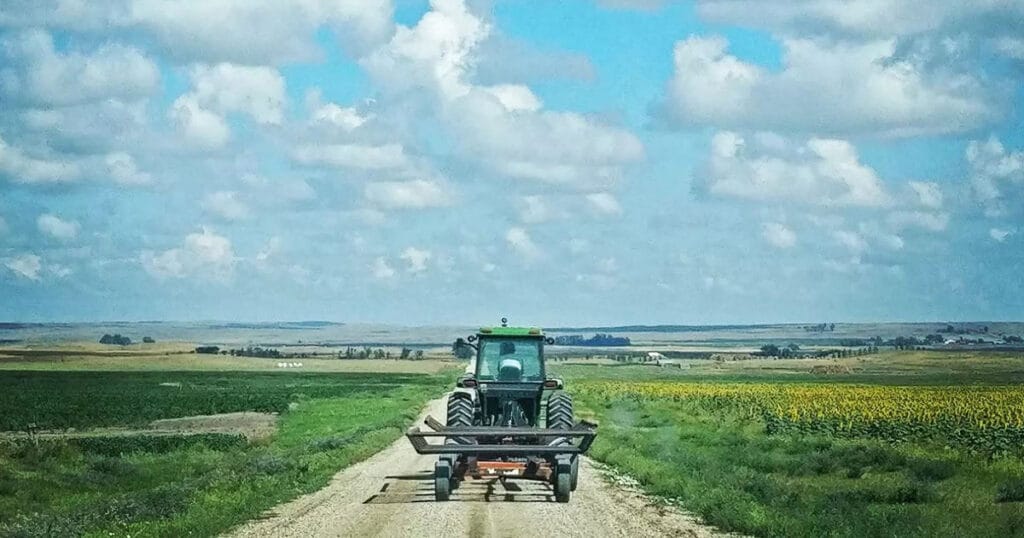
Jarett Keith does mental math for a living. This year, it’s just not adding up like it once did.
The 33–year-old has been on the family operation near Sherwood, North Dakota since he was six years old. This spring, dry urea fertilizer was running $875 a ton and most of his fields need 250 to 400 pounds. That penciled out to $150 to $200 an acre before seed ever went in the ground.
“I didn’t have all the planning figured out for this year in order to buy at a lower price,” Keith said.
Fuel is its own math problem. A 10,000-gallon tank won’t get him through harvest. He estimates the fuel bill alone costs about $10 an acre.
“On the diesel side, there’s really not a whole lot we can do,” Keith said. “We don’t really have a choice for that.”
Keith took on an extra 400 acres this year — bringing his operation to 2,400 acres — in part to spread fixed costs (machinery payments, the expenses that don’t scale directly with land) across more ground. He leaned into soybeans and field peas, which cost far less to fertilize than corn or canola.
“Those were really the only choices we had in order to cut back,” he said.
What Keith is experiencing is the kind of quiet, constant recalculation happening on farms throughout North Dakota and western Minnesota this year, as tariffs, elevated input costs and a war thousands of miles away collide to squeeze producers from both directions at once.
A market in whiplash
Matt Perdue, president of the North Dakota Farmers Union, is blunt about what the past two seasons have looked like from his vantage point.
“Within the last several years, there’s been a great deal of volatility in the marketplace,” Perdue said. “The story of 2025 — tariffs. The impact of supply chain disruption.”
Farmers Union has spent the past year playing defense — helping members navigate a market that keeps moving under their feet. Perdue said he wants a calmer geopolitical environment and a farm safety net that actually works for producers.
“We are likely forced to rely on ad hoc support to supplement that safety net,” Perdue said. “That’s not sustainable long-term.”
Perdue said for many folks (and grain farmers in particular), the current situation has made it “very challenging — impossible, for others — to break even.”
Cory Hart runs a 9,000-acre grain operation in Wells County, alongside some beef cattle. He said he watched the tariff fight with China greatly affect corn, soybean and wheat prices last year. After the administration renegotiated trade agreements and pulled tariffs off imports, he said, things have loosened somewhat.
“Until he eased off on tariffs on China, it wrecked our market last year,” Hart said, referring to President Trump.
But the reprieve isn’t once size fits all. China has resumed buying beef from South America, which Hart said is bringing down cattle markets, even though retail beef prices are staying stubbornly high.
Fertilizer prices were another volatile story this year. Urea had dropped roughly $400 a ton by July with a crop already in the ground. Then came renewed war with Iran and the prices went up $125 in a single week by Hart’s math.
“Between fuel and fertilizer, there isn’t anything in this country that doesn’t get transported by truck at least twice,” Hart said. “If we hope to net $100 an acre, fuel and fertilizer are going to take $30 to $40 of that.”
At Audubon Co-op in western Minnesota, General Manager Kevin Hamernik has a great vantage point to see how those pressures show up at the elevator scale. Basis levels haven’t changed much year over year and most farmers have already sold enough of their crop to cover input costs, with the exception of some wheat being held back to wait for better pricing, Hamernik said.
Export markets went down after the initial round of tariffs, but have “made a fair recovery since,” Hamernik said. China is slowly buying again and other countries have filled some of that gap. Corn exports, Hamernik noted, are running roughly 25 percent ahead of last year, even as the price farmers fetch is lower.
“Input costs and interest rates are a concern as well,” Hamernik said. “Realistically, the export market and domestic use is only part of the equation.”
Not everyone is losing
While grain farmers struggle, some in North Dakota agriculture are doing better than they have in years. Pete Kronberg runs 40 head of cattle and 700 sheep in Dickey County. He said the operation is largely insulated from the tariff fight, as well as input costs.
“We don’t buy fertilizer — don’t need chemical fertilizer,” he said. “We don’t use that much diesel.”
What has been hard to find, Kronberg said, are antibiotics for treating animals. It’s a supply chain problem.
Kronberg added that beef and sheep prices are “crazy good,” the result of years of policy that pushed acres toward corn and soybeans, squeezing supply on the livestock side.
“When (elected officials) made the decision to subsidize all the things on the farmer side of things, the result was getting rid of beef and sheep operations,” Kronberg said, something he doesn’t expect to reverse “until a credit crunch.”
Calli Thorne is co-owner of Yellowstone River Beef and Triangle M Ranch & Feedlot near Watford City. She explained there’s a similar dynamic in the retail side of a direct-to-consumer beef operation.
“Cattle prices are really high,” she said. “My beef prices are higher because the cattle prices have skyrocketed. Margins in that business have always been tight and now they’re even tighter.”
Even so, she added, ranchers are “finally getting close to what they should be getting paid” following years of thin profits. Consumers absorb the cost at the meat counter or — in Thorne’s case — at the ranch’s retail counter.
How this compares to the 1980s
For historical perspective, few know more about the topic than Dr. John Ikerd, professor emeritus of agricultural economics at the University of Missouri. He lived through the 1980s farm crisis both on the farm family side of things and, later, as an economist studying it.
Ikerd sees a real comparison to that era’s cost-price squeeze. The difference, he said, is in scale.
“Farm bankruptcies have risen the past few years, but are nowhere near those of the 1980s,” he said. “Today’s hundreds of bankruptcies are compared to thousands in the 1980s. Today’s debt-to-equity ratios are much lower and interest rates are about half of what they were.”
However, he cautioned that the status quo “could evolve into a crisis if there was a domestic and global recession similar to the 1980s.”
The ongoing trade disruption is more sweeping than the 2018-19 trade war, Ikerd said, because this time it affects “all of the U.S.’s trading partners, traditional allies as well as traditional adversaries.” He compares it to the isolationist policies of the early 1900s, adding that “it took the Great Depression and World War II to bring the U.S. back into the global economic community.”
Ikerd said hogs, soybeans and corn are the upper Midwest commodities most likely to be affected by retaliatory tariffs. He’s skeptical markets lost to South America will just come back when tariffs are lowered.
“I believe the U.S. has reached that point of no logical return,” he said.
Pain isn’t distributed evenly across farm sizes, Ikerd argues. Large operations, he said, have been built on the — albeit implicit — promise of a federal bailout in bad years, which has created a “too big to let fail” dynamic. The mid-sized farms that balance farming as a livelihood and a lifestyle get squeezed the worst.
What the numbers show
Statistics bear out the shape of the squeeze, although the scale is not yet comparable to the 1980s. Per acre input costs for spring wheat and corn are running higher than 1988 levels, even after adjusting for inflation, according to NDSU’s projected 2026 crop budget outlook for north central North Dakota. Spring wheat is at $330 an acre versus an inflation-adjusted 1988 price of $289; corn at $468 compared to $432. Soybeans are actually cheaper to grow today (an exception) at $259, versus $536 in 1988 dollars — although that crop’s export market has recently been disproportionately affected by tariffs.
Vern Thompson farmed though the 1980s crisis himself before serving in the North Dakota Legislature. He points out the state’s shrinking number of operations as one way it compares to the 1980s.
“We have been losing 1.28 farms or ranches per day in North Dakota since 2009,” said Thompson, the Dem-NPL candidate for ND agriculture commissioner.
Meanwhile, the average farm in the state has grown from 1,042 acres to 1,552 acres these days. That’s a function, Thompson said, of decades of policy at both the state and federal level rewarding scale.
Thompson sees one silver lining for established farmers that they didn’t have in the ‘80s: equity. With high land values, farmers who bought many years ago can leverage its value to get through a difficult growing season.
“However, this means conditions are terrible for farmers just starting out,” he said.
That’s the dividing line running through the state’s agriculture now. It’s not a single crisis, but a fracture between those with land equity to lean on and those, like Keith, who are still running the numbers to see if this is the year the operation falls apart.
Politicians react to the farm crisis
With President Donald Trump’s tariff policies and war with Iran leading to the volatility in agriculture, people are starting to speak up, according to Sam Wagner of the Dakota Resource Council.
“First and foremost, stop the tariffs,” Wagner said. “They aren’t working and no one is trusting the federal government. The difference between the 80s is there are not as many farmers as there were back then, and many of them will just take the subsidy and shut up, but they are starting to get a bit more fed up lately. There is a revolt in the GOP in North Dakota. Not one of the incumbents showed up to the state GOP convention. But the money is still winning for now.”
When reached for comment, Sen. John Hoeven (R-ND) provided a statement acknowledging the challenges facing farmers and ranchers, while promising to work to “provide relief including helping to secure assistance through the Farmer Bridge Program and under the Working Families Tax Cut Act.”
“We enhanced crop insurance and made improvements to Agricultural Risk Coverage and Price Cost Coverage that come into effect fully in October,” Hoeven said.
Hoeven said “the Trump administration is working to get better, long-term trade agreements that will help to level the playing field for our farmers, ranchers and all our exporters. To help with increased input costs, we are also working to produce more energy here at home to bring down costs, as well as develop local sources for fertilizer to reduce our dependence on foreign sources.”
Republican North Dakota Sen. Kevin Cramer’s own statement credited Trump with promoting fairness with trading partners and knocking down barriers to trade.
“The president has ended the regulatory assault on agriculture and is using every tool at his disposal to onshore supply chains and lessen our reliance on foreign countries for critical agricultural inputs,” Cramer said.
To that end, Cramer said he has encouraged the president to focus on building relationships with friendly countries such as Canada who want to do business with the U.S.
“I have been encouraged by trade agreements so far and look forward to more fair agreements enabling our farmers and ranchers to sell their products all over the world,” he added.
While noting the federal efforts for long-term solutions to the farm crisis have fallen short, Wagner saved his wrath for North Dakota’s at-large congresswoman, Republican Rep. Julie Fedorchak.
“She has been absolutely absent from our state in a way that I have not seen in my lifetime,” Wagner said. “She will not show up for any town halls or anything that isn’t the elites and she’ll brag about it, even. I don’t know where her supporters are coming from, but she is unpopular with a large group of people. I don’t know what the independent vote looks like in North Dakota, because we don’t have voter registration, but primary voters against Fedorchak plus Dem supporters equals more votes than Fedorchak. There is a path.”
Fedorchak’s spokeswoman Kate Roberts vigorously defended the congresswoman’s actions regarding agriculture and accessibility.
“Notably, Fedorchak has held 11 Fedorchak Forums, where more than 25,000 North Dakotans have participated,” Roberts said. “She and her team have also held more than 1,500 meetings with North Dakotans and dozens of office hours across the state, allowing North Dakotans to meet with Julie or a member of her team one-on-one to solve issues and share policy ideas.”
Roberts pointed to the congresswoman’s appearance in the state with the Agriculture Secretary Brooke Rollins. She also met with U.S. Trade Representative Julie Callahan “to discuss trade, market access and the challenges facing producers directly with farmers and ag leaders.”
“North Dakota’s farmers and ranchers are among the most resilient people in America,” Fedorchak said in a statement. “But they are facing pressure from high input costs and uncertain markets. Producers cannot control the price of diesel or fertilizer, the weather, or disruptions in global trade.”
“They deserve certainty and a government that understands what is at stake,” she said. “I have listened to our farmers and addressed their top priorities: passing a farm bill, year-round E15, estate tax improvements and strengthening crop insurance and reference prices.”
This is part one in a two-part series about the farm crisis. Read more about the mental health challenges farmers and ranchers face here.
 Fargo voters reject switch to ward-based council governanceOct 7, 2026
 Minnesota Voter Guide: Clay County Board editionSep 24, 2026
 Moorhead Voter Guide: City Council EditionSep 23, 2026
 Voter Guide: Moorhead Mayor EditionSep 20, 2026
 Farmers in crisis: mental health matters on the prairieSep 16, 2026
 Fargo voters to choose between commission, council governments in OctoberAug 20, 2026