

The price of diesel has risen to record levels in recent months. To explain the situation, the High Plains Reader caught up with AAA spokesperson J. Skyler McKinley. He’s in charge of media relations, government affairs and community engagement for AAA across a three-state territory covering North Dakota, Minnesota and Colorado. After running a few political campaigns, McKinley went on to hold several roles in Colorado state government, most notably as the founding Deputy Director of Colorado’s Office of Marijuana Coordination — the state office responsible for coordinating the rollout of legal marijuana policy. He then served as press secretary for former Colorado Governor John Hickenlooper before joining AAA in 2017.
When the HPR interviewed McKinley earlier this month, he discussed the diesel situation in the Upper Midwest, and in the United States more broadly. He explained the complexities of the reasons behind the record high prices — not just the Iran War crude oil situation but also the refinery issues at hand. Additionally, he put the problem in perspective, comparing current prices to where they were a year ago and discussed the consequential implications of high diesel prices on the cost of literally almost everything. Finally, he told the HPR that the diesel price situation is unusual, but not completely unprecedented.
High Plains Reader: How does the diesel price in Minnesota and North Dakota compare to the national average and to what it looked like this time last year?
Skyler McKinley: There’s not a lot of good news right now in diesel. The only good news in North Dakota and Minnesota is we’re paying a little bit less than the national average. North Dakota average, as of right now, is $6.09 a gallon. Minnesota is $6.21 a gallon. The national average, though, is $6.37, so we’re doing a little bit better than the national average, though not that great altogether. All told, North Dakota is 28 cents under the national figure; Minnesota is 16 cents under it, so it’s really decimal dust, but it is a little bit cheaper than the national average.
A year ago, the same gallon of the same diesel fuel would have cost $3.45 in North Dakota, $3.59 in Minnesota and $3.70 nationally. So if we’re just looking at the increase over last year, all three are up between $2.62 per gallon and $2.67 cents a gallon. So that is a more than 70% increase over this time last year.
HPR: What can we blame this on? My understanding is there’s a situation with the Russian diesel refinery capacity as well as the Iran crude oil situation.
JSM: There’s a lot going on with diesel. First off, how did we get to the point where our jumping off point is so high? Prices on crude oil — and remember. diesel prices are downstream of crude oil — rose after the war began in late February and they stayed high through the summer, right? So North Dakota, as a function of the commodities market for crude oil, was at $4.93 a gallon on July 31.
At the same time, there are a lot of refining issues playing out relating to how fuel is moving through the system. Remember, because of the prolonged closure of the Strait of Hormuz, the whole oil market had to react. That has led to a reduction in refining capacity both domestically and internationally. So even though crude oil is moving around, and even though crude oil is not at an all-time high, refining capacity is limited — and refining capacity is what converts your crude oil into diesel fuel that you put into trucks.
Then we get to the recent spike. So remember, $4.93 on July 31. We went — in North Dakota — from $5.34 to $6.25 on Sept. 21. So that’s 90 cents in three weeks. Minnesota went from $5.50 to a record $6.35 on Sept. 22.
Prices have fallen since – which is some good news. We’re still high. And why is that? Well, there are demand patterns this time of year.
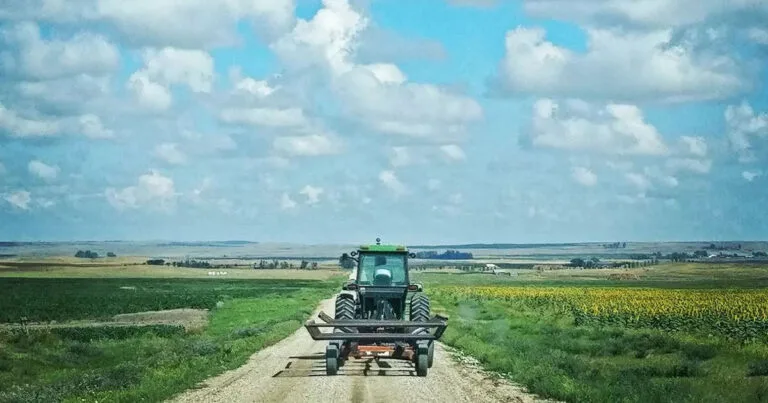
Three things you should know about — well, two big things. One, it’s the fall harvest. So there is a major need for diesel fuel for your John Deere tractors. And so we see an increase in demand this time of year. You typically see demand for gasoline fall, but crude oil rises this time of year.
Related to that, while they are technically different fuels, they are chemically almost identical — diesel fuel to heating oil. And parts of the country that use heating oil to heat their homes need that fuel. So that is now in the refining mix as we look ahead to the fall and winter months. So you have had extremely limited supply, plus the fact that crude oil is trading as a commodity at high numbers, plus the fact that demand is up, all coming together in September to lead to high, high prices.
HPR: How is this affecting everyday drivers who use diesel vehicles — trucks and work vehicles — versus the general gas price story most people follow more closely, which is also pretty high?
JSM: It’s different. Most drivers don’t use diesel, but for folks who do drive diesel, they’re absorbing about twice the increase that gas drivers are. Regular fuel is up about $1.30 a gallon from a year ago. Diesel is up more than $2.60. In North Dakota, diesel cost 50 cents more than regular a year ago and $1.90 more than regular today. So a 30 gallon fill in North Dakota right now will cost you $183 compared to $103 last October.
So who’s paying that, right? Well, we know farmers are paying it for their farm equipment and margins are really slim on farming. We know that folks that own their own businesses in the trades are driving diesel trucks as work trucks. They’re paying it. But guess what? We’re all paying it. Because if you bought anything that was delivered to your door by Amazon or you bought it at the local grocery store, it got to you by way of a commercial motor carrier. Commercial motor carriers run on diesel. Those are semis. And so the cost of just about everything is going up.
So who’s feeling it most intimately? Definitely small business owners in the trades and in agriculture. Truckers are feeling it. They’re also small business owners in many cases. But the American consumer is feeling it, because when diesel is more expensive, everything is more expensive.
HPR: That includes things that travel by rail, also. That’s diesel as well, isn’t it?
JSM: Yeah, and guess what? Cargo ships also use a blend that affects the diesel distillate process. Everything in our economy, no matter how it gets to you, is at some point looking at diesel in its pipeline. And look, this is as simple as the stuff that gets delivered to you or as complicated as the fact that — let’s say as a hypothetical, I am a plumber and I have to drive to your house to help you because your dishwasher’s not working. That now costs me more. And that it costs me more to get to you, it’s going to cost you more to make me whole — and the cost rises on everything.
HPR: Has AAA noticed any shifts in travel generally and with diesel costs specifically?
JSM: Not yet. You know, what’s interesting is we set records for Memorial Day and July 4. People are still traveling. Is there a potential chilling effect on travel? Yeah, absolutely. Prices are higher. Airfare is going to be higher for Thanksgiving and Christmas. I think we might see some of this play out more clearly for the year end holidays. To date, there has not been a dramatic reduction in travel. Perhaps there’s been a concentration in travel. So we don’t survey travelers, which is what we’re known for — surveys — for every day of the week. We survey them for the holidays. And for the holidays, folks were still traveling.
If I were to speculate a little bit on this — and I am speculating, so take that for what you will — we have a tale of two economies. For the folks who can afford to travel — and regularly travel — the 10% cost increases on some of these travel products probably don’t change their calculus.
For the millions of Americans who don’t travel at all, it’s gotten that much harder, so the rate the travel economy might grow has shrunk, I think. I’ll give you an example. We forecast 70 million Americans traveled for July 4. The vast minority of Americans. There’s over 300 million Americans. So most Americans don’t travel for the holidays. And the question for me is whether that number is widening or falling.
HPR: Is there any relief in sight?
JSM: That’s an open question. You’ve got some news coming out of the G7 today that some strategic reserves are being tapped. Look, anyone who tells you what crude oil, what gasoline, what diesel is going to do tomorrow, is lying to you. We can point to general trends in supply and demand, but we can’t pinpoint them. And right now, the questions that will most meaningfully move the needle on diesel relate to questions of international lawfare and warfare and complicated refining capacity. Those are tough questions to answer.
So, will diesel prices fall again in my lifetime? You betcha. Will they fall dramatically between now and next week? Probably not. Looking beyond next week, I’d be lying to you if I told you what was going to happen.
HPR: Does AAA track or advocate on policy issues tied to fuel taxes and infrastructure funding or price transparency with respect to diesel?
JSM: We do to the extent that we started out over 100 years ago as a motorist advocacy organization — to get the roads paved, to make it safe to get where you were going, to make automotive mobility possible for as many Americans as possible. And we still have that role.
What’s interesting is that these conversations about gas taxes and fuel taxes cut against robust infrastructure. If you cut fuel taxes to save money for consumers on gases, you end up spending a lot more money on potholes, which they don’t like as much. So we are not, at this time, in North Dakota or Minnesota, advocating for any changes to the gas tax.
We’re watching all of this carefully, but the best way to save is to be strategic in how you get around. And that’s what we’re helping motorists the most with now, from trip planning, through fuel savings you can get in the AAA app and our discount network and frankly, through conversations like this one. But we are not calling on anyone to change their policies with regard to fuel taxes until we know how this stuff is going to shake out and before we know what the impact is on infrastructure generally.
HPR: Are you aware of North Dakota Gov. Kelly Armstrong’s decision to allow dyed diesel (ordinarily restricted to off-road farming uses) on public roadways?
JSM: I’m aware of it. You know, here’s what I would say generally about these diesel issues; you know, 80% of the cost of fuel relates to how crude oil is moving around the system. What we can do at the margins is at the margins. And by “we,” I mean folks like the governor who are not running a major oil and gas company, right? So it’s complicated. Will there be significant savings from these levers we can pull? It’s really hard to know. Because one small thing could happen internationally or with the oil markets and it could completely erase any potential savings and you can’t pull out the independent variables, because this is so complicated. So you can’t see one thing and say, “what was the impact of this one thing?” because it’s really hard to adjust for the literal millions of “just one things” that play out over the course of our international fuel system. It’s kind of like chaos theory, right? Does a butterfly flapping its wings in Manhattan cause a tsunami in the Pacific? Does a governor allowing for dyed diesel change the nature of refining capacity? And in both questions, the answer has to be, I don’t know.
HPR: What other times in American history compare to the diesel situation we have today? I know the prices are records, but adjusted for inflation, has there been a worse diesel price shock previously and what other time periods remotely compare?
JSM: These are not unprecedented times when it comes to fuel, but they are abnormal. So knowing that we’re living in an abnormal time is a useful reminder to collect as much information as you have, but don’t let yourself set expectations.
These are record prices in dollar terms, but after adjusting for inflation, diesel cost more in the summer of 2008. The national average peaked at $4.76 a gallon that July, which is about $7.25 in today’s dollars.
This year’s peak was $6.53 in late September. All of this comes from the federal Energy Information Administration’s price history. The closest comparison is 2022, after Russia invaded Ukraine. Diesel topped out at $5.81 that June, or about $6.56 now, so this year is roughly even with it.
What sets this year apart is the speed. Diesel rose 96 cents in a single week in early March, the largest weekly jump in records that go back to 1994. From February to September, it climbed about 66% after inflation, the steepest seven month run in data going back to 1979. Diesel has also never cost this much more than gasoline. The gap averaged about $1.94 a gallon in September. The previous high was $1.57 in November 2022.
Two earlier periods are worth a mention, though neither reached these levels. After the Iranian Revolution, diesel doubled from 61 cents in early 1979 to $1.22 in 1981 — but that took more than two years and peaked near $4.58 in current dollars. When Iraq invaded Kuwait in 1990, the price jumped 46% in three months and had mostly faded by the next spring.
This is Part 1 of a two-part series on how high diesel prices affect the global, national and regional economies. Part 2 will explore the entire supply chain, from farms and truckers to grocers and consumers, and examine the ripple impact of the high diesel prices on each item transported by truck, rail — or even barge.
 Fargo voters reject switch to ward-based council governanceOct 7, 2026
 Minnesota Voter Guide: Clay County Board editionSep 24, 2026
 Moorhead Voter Guide: City Council EditionSep 23, 2026
 Voter Guide: Moorhead Mayor EditionSep 20, 2026
 Farmers in crisis: mental health matters on the prairieSep 16, 2026
 Farmers in crisis: recalculation in farm countrySep 4, 2026