



Live and Learn | March 9th, 2015
I’m trying to think “intervallically.” No, it’s not the new math or a metaphysical dimension in the space-time continuum. I’m just learning to play the piano. I never took piano lessons growing up, and when I tried it for the first time as an adult, it didn't take. I memorized the individual notes in every piece, but each additional song I learned replaced the one before it. After nearly two years, a handful of music books and dozens of pieces of music, I could perform a grand total of one song: the one I had just learned (it was a thankfully brief recital). This time around my teacher is getting me to see musical intervals, that is, the relationship between the notes, the chords and the structure of the music. For me, thinking intervallically means finding the patterns in the music.
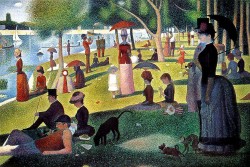
Across disciplines, in humans as in nature, the pattern is preeminent. In the eye, a single red, green or blue “cone” can’t see color; only the pattern of signals from all three allows us to discriminate wavelengths. Look closely at Georges Seurat’s “A Sunday Afternoon on the Island of La Grande Jatte” and you see nothing but individual specks of color. But step back to reveal how the dots create patterns and you have a masterpiece. In cells, one amino acid left off of a nucleotide chain, or one too many copies of a gene along a chromosome undoes the pattern and can lead to devastation for the organism. In the brain, a single neuron can’t tell us anything about how we think or achieve consciousness. But the overall pattern and location of neuronal activity reflects whether we are awake or asleep, depressed or elated, if we are looking, listening or remembering, perhaps even if we are lying.
We know that memory works best when you create a pattern to connect the information. Ironically, we know this because the pioneering psychologist Hermann Ebbinghaus failed to find the limits of his memory because he was trying to remember meaningless nonsense syllables. We extend memory when we connect or “chunk” items together into patterns, making new wholes out of the individual parts. The movement of individual drops in the ocean doesn’t describe the action of a wave. Physicists know that particles behave differently when viewed as discrete entities versus a continuum of waves.
Even highly practiced skills like reading depend not on the individual items like letters, but the context of the sentences and words. You can manage to read your aunt’s scribbled handwriting or even sentences where entire words are jumbled up: “tihs is bcuseae the huamn mnid deos not raed ervey lteter by istlef, but the wrod as a wlohe.”
Patterns are so important that our brain seems programmed to search for them, sometimes finding patterns where none exist or switching between alternate interpretations of a pattern that doesn’t change. A simple line drawing of a 3D cube will seem to flip-flop in depth as our brain searches for the “correct” meaning from the unchanging pattern.
Carl Jung said that humans have a tendency to find “archetypes” or meaningful patterns that persist over time: for example, masculine and feminine, or good and evil. In social psychology, stereotypes are ways of thinking about people or situations that are built on patterns of information, often an incomplete pattern and sometimes leading to dire consequences such as prejudice and discrimination. Recently a department store was forced to remove holiday wrapping paper from shelves because a shopper complained that upon close inspection the pattern looked like tiny swastikas.
Even children and infants respond to patterns such as those in language and music. When a four-year-old says, “Uh oh, I breaked the glass!” he has demonstrated the pattern for forming past tense in English, despite not yet attending “grammar” school or having diagrammed a single sentence. And long before they learn any particular language, babies recognize and respond to the musical qualities of speech. That sing-songy “motherese” we use when talking to babies emphasizes the melodic pattern; the words are irrelevant. It’s a good thing too, because I doubt the lullaby would be as effective if babies understood the lyrics “When the bough breaks the baby will fall…” The melody, the pattern of notes, is what gives the emotional meaning. As with reading, musical notes can be inserted or deleted, and whole melodies transposed into another key, but the pattern remains the same and both adults and infants recognize it as such.
And so I am trying to get my brain to convince my fingers to find the patterns hidden among these 88 keys. Or perhaps it’s my fingers that need to convince my brain? All I know is that this is going to take some time and lots of effort. You know what they say about how you get to Carnegie Hall, right?
[Editor’s note: Dr. Nawrot is Professor of Psychology and Director of the Child Development Lab at MSUM. She earned a Masters degree and a Ph.D. from the University of California Berkeley, and has been working on her M.r.s. and M.o.M. degrees for nearly 20 years.]
January 15th 2026
April 3rd 2025
March 15th 2025
March 15th 2025
December 19th 2024

__293px-wide.jpg)
_(1)_(1)_(1)_(1)_(1)_(1)_(1)_(1)__293px-wide.jpg)
_(1)_(1)_(1)_(1)_(1)_(1)_(1)_(1)__293px-wide.jpg)
__293px-wide.jpg)


By Bryce Vincent Haugen By all accounts, Democratic-Farmer-Labor U.S. Senator Amy Klobuchar — first elected in 2006 — is the most popular active politician in Minnesota, whether she’s judged by polling or by her four electoral…

Saturday, June 13, 10 a.m.- 5 p.m.Paradox Comics-N-Cards, 814 Main Ave., FargoCalling all nerds: it’s time to get down and nerdy with vendors aplenty, who are selling comics, toys, video games, board games, various collectibles…

June 6-7StatewideYou grab a line and I’ll grab a pole — and if you’re a North Dakota resident, you can head on down to your favorite fishing hole, no license needed (for this weekend, anyway). All other rules still apply…

By John Strand It took us over 30 years for us to reach out and ask for your help. The High Plains Reader has always been subscription free and paywall free. Our content has — and always will be — free to access for all of our…

By Ed RaymondWere women created to do the work of God?One of the first requests made by new Pope Leo XIV was to invite an expert on the alt-right conservative Catholic organization known as Opus Dei to brief him about its…

By Rick Gionrickgion@gmail.com Holiday wine shopping shouldn’t have to be complicated. But unfortunately it can cause unneeded anxiety due to an overabundance of choices. Don’t fret my friends, we once again have you covered…

By Rick GionThe scarfing of canned fish and seafood products by online food influencer types is hard to miss on social media these days. Some of the consumed morsels range from exquisite to downright nasty. However, there are many…

By Bryce Vincent Haugen The curtain has come down on Jade Presents. Fargo-Moorhead’s largest event promoter has brought thousands of shows — more than 150 per year — and hundreds of artists to the area over the past 36 years. On…
__300x100.png)
By Greg Carlson Steven Spielberg, who will turn 80 this December, returns to the subject of aliens among us in “Disclosure Day,” his first feature since “The Fabelmans” in 2022. Now closer to the end than the beginning of…

By Jacinta Zens I recently sat down for a chat with ceramicist Louie Albertson, Clay and Studio Program Manager at the Plains Art Museum. Before the interview, I had the pleasure of getting to know him a bit as a colleague when I…

Saturday, January 31, 6:30-9 p.m.Transfiguration Fitness, 764 34th St. N., Unit P, FargoAn enchanting evening celebrating movement and creativity in a staff-student showcase. This is a family-friendly event showcasing pole, aerial…

By Annie Prafckeannieprafcke@gmail.com AUSTIN, Texas – As a Chinese-American, connecting to my culture through food is essential, and no dish brings me back to my mother’s kitchen quite like hotdish. Yes, you heard me right –…

By Sabrina Hornungsabrina@hpr1.comNew Jamestown Brewery Serves up Local FlavorThere’s something delicious brewing out here on the prairie and it just so happens to be the newest brewery west of the Red River and east of the…

By Eli Liverani Cholesterol is probably one of the first molecules I have ever heard of in my childhood. Most of the relatives on my mother's side had high cholesterol in their blood, and apparently, levels above a certain range…

January 31, 11 a.m. - 6 p.m.Viking Ship Park, 202 1st Ave. N., Moorhead2026 marks 10 years of frosty fun! Enjoy sauna sessions with Log the Sauna, try Snowga (yoga in the snow), take a guided snowshoe nature hike, listen to live…

Chris M. Stoner I was recently dismissed from my role as drag show director and emcee for Dakota OutRight, a role I had been fulfilling for more than two decades. The reason given? My political commentary during shows, while…